Read Before Discarding: The People Who Decided Nobody Else Would Save the Instruction Manual
The first thing most people do with an instruction manual is lose it. The second thing they do is throw it away. For a particular kind of collector, both of those actions register as a minor tragedy.
These are the people building archives around product documentation — the thin, staple-bound booklets that shipped with 1970s food dehydrators, the fold-out diagrams tucked inside discontinued reel-to-reel tape decks, the warranty inserts for microwaves that stopped being manufactured before some of their archivists were born. It's a preservation effort that doesn't get much attention, partly because the objects being saved are so deliberately mundane, and partly because the people doing it tend to prefer the work over the spotlight.
But spend any time inside these communities — scattered across forums, personal websites, and a few very active Discord servers — and you start to understand why they take this so seriously.
A Manual Is a Snapshot of What People Were Supposed to Know
The argument these collectors make isn't really about nostalgia. It's about information density.
A user manual for a consumer product tells you things no advertisement would ever say out loud. It tells you what the manufacturer assumed the average buyer already knew. It tells you what they thought needed explaining. It tells you which safety warnings were legally required versus which ones reflected genuine anxieties about how the product might be misused. Read enough of them from the same decade and you start to assemble a picture of everyday domestic life that you simply cannot get from looking at the product itself.
Take something like a late-1960s electric carving knife. The appliance still exists in some form today. But the manual from that era — the one explaining, in careful and slightly condescending prose, how a housewife might use this remarkable new tool to serve a roast — is a document about gender, technology, marketing, and the specific texture of American middle-class aspiration in that moment. Toss the manual, and you keep the object but lose the context.
That's the core of what these archivists are arguing. The manual is the primary source. The appliance is just the artifact.
The Crumbling Problem
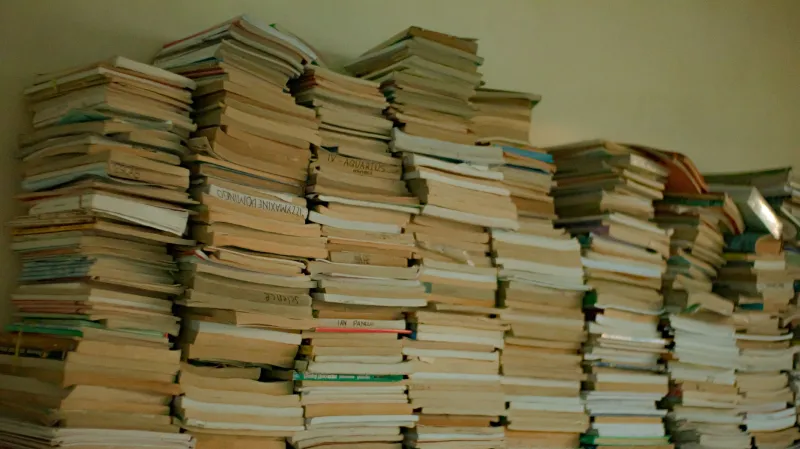
Paper from the postwar era through the 1980s has a particular problem: it was often made cheaply, and it's aging badly. The kind of newsprint-adjacent stock used for instruction booklets wasn't designed to last. It yellows, it becomes brittle, it foxes at the edges. A manual stored in a garage in Phoenix or a basement in Minneapolis has probably been through temperature swings that accelerate that deterioration significantly.
This is why digitization is such a priority for the more organized corners of this community. Getting a clean scan before the pages start shedding is the whole game. Some collectors have invested in flatbed scanners with document feeders and built out methodical workflows — logging the product name, manufacturer, model number, year of manufacture where known, country of origin, and condition before anything else gets touched.
A few of the larger personal archives have tens of thousands of documents. One collector, who runs a website that looks like it was built sometime around 2004 and has clearly never been updated for mobile, hosts manuals for kitchen appliances alone that span six decades and multiple continents. The site has no ads, no newsletter, no social media presence. It just exists, indexed by Google, silently useful to repair technicians and historians and the occasional person who found an old waffle iron at an estate sale and wants to know if the heating element is supposed to glow that color.
The Computer Peripheral Problem Is Its Own Rabbit Hole
If kitchen appliances are the entry-level collection, obsolete computer hardware documentation is where things get genuinely arcane.
The 1980s and early 1990s produced an almost incomprehensible volume of peripheral devices — dot matrix printers, external modems, early optical drives, proprietary storage formats that were obsolete within three years of release — and each one shipped with documentation. Some of it is technically critical. If you're trying to get an old piece of hardware running on a vintage system, the manual isn't optional. The configuration jumper settings, the DIP switch positions, the IRQ and memory address conflicts — none of that is guessable. Without the documentation, the hardware is a paperweight.
Collectors in this space tend to have a more pragmatic bent than the kitchen appliance crowd. They're often active in retrocomputing communities, and their archiving is as much about functionality as history. But the historical impulse is there too. Early personal computing was a genuinely strange cultural moment, and the documentation reflects that strangeness — the optimism, the jargon, the assumptions about who the user was and what they wanted to do.
What Gets Lost When Instructions Disappear
Here's a thing that doesn't get talked about enough: user manuals are one of the few places where manufacturers wrote directly to the person using the product, not the person buying it or the person approving the purchase. The voice in a good instruction manual — patient, practical, occasionally a little nervous about liability — is a specific kind of corporate communication that doesn't really exist anywhere else.
When those documents disappear, we lose a record of that relationship. We lose the evidence of what companies thought their customers needed to be told, and how they chose to tell it. We lose the warnings and the diagrams and the troubleshooting trees. We lose the little illustrations of hands demonstrating the correct grip, the footnotes about voltage differences for international models, the cheerful assurances that this product will provide years of reliable service.
We also, practically speaking, lose the ability to fix things. Right to repair is a conversation happening in legislatures and courtrooms right now, but the infrastructure for actually repairing older products depends heavily on documentation that nobody was ever formally responsible for preserving.
The Archive Nobody Commissioned
None of this work is being done by museums, or universities, or manufacturers. It's being done by individuals who decided, for reasons they sometimes struggle to articulate fully, that these documents were worth their time.
That's a pattern that shows up a lot in preservation work — the gap between what institutions decide is worth saving and what actually matters to people gets filled, quietly and without much fanfare, by obsessives with flatbed scanners and too much storage space.
The instruction manual collectors are just the latest version of that story. They're not asking for recognition. They're asking you to maybe think twice before you put that old booklet in the recycling bin.
Somebody out there wants it. And they'll probably scan it and put it on a website that looks like it was built in 2004, where it will sit forever, silently useful, waiting for the one person who needs it.