Somebody Has Been Mapping Every Tenant That Ever Existed in Your Hometown Strip Mall
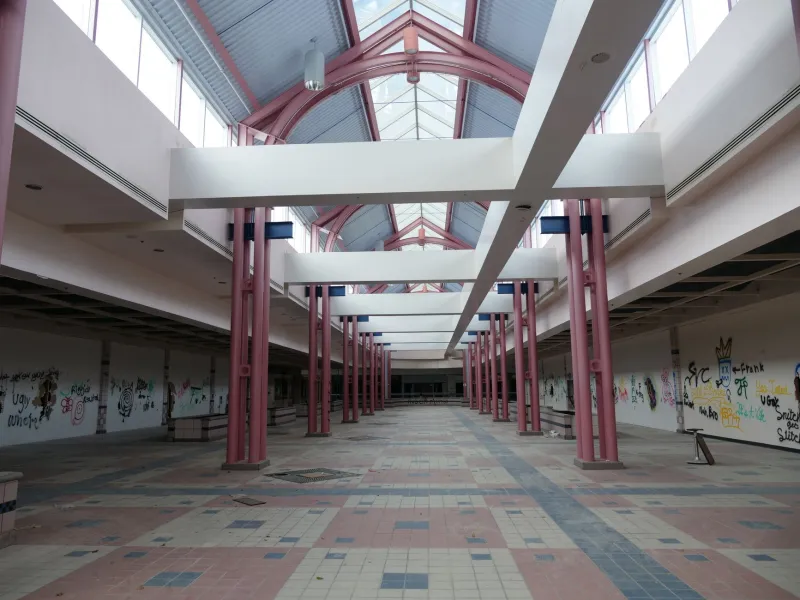
There's a strip mall on the edge of your hometown — or there was, or there almost certainly will be — sandwiched between a gas station and a slightly larger strip mall. Right now it has a nail salon, a phone repair place, and a unit with paper over the windows that used to be something else. You probably don't think about it much. A small, scattered group of people think about almost nothing else.
They're not developers. They're not real estate agents. They're the retail archaeologists — a loose, informal network of hobbyists, amateur local historians, and quietly obsessive suburbanites who have taken it upon themselves to document the full chronological tenant history of commercial strip spaces across America. Every business that ever moved in. Every business that quietly died. Every awkward in-between month when a storefront sat dark and waiting.
And the databases they're building are, depending on your tolerance for this kind of thing, either completely useless or genuinely fascinating.
The Work Nobody Assigned Them
Ask anyone doing this how they got started and you'll usually get some version of the same story. They drove past an old shopping center, something clicked, and they started wondering: what was here before? One researcher in the Midwest — who posts under a handle on a regional history forum and asked not to be identified beyond that — described spending three weeks reconstructing the full tenant timeline of a single strip mall in his city that opened in 1979 and has since housed, among other things, a video rental store, two different pizza chains, a tanning salon, a check-cashing place, a brief and apparently ill-fated attempt at a wine bar, and what locals still refer to simply as "the karate place."
His tools are not sophisticated. Old phone directories. Digitized local newspaper archives, many of them only partially scanned and deeply annoying to search. Google Street View's historical imagery feature, which captures snapshots going back to roughly 2007 in most markets. Photographs sourced from people who happened to post family snapshots online that accidentally captured a storefront in the background. Oral histories from people who actually remember.
That last one is surprisingly productive. "People remember the stores from their childhood with a weird amount of precision," he said. "They forget the name but they remember the smell, or the carpet color, or that it was next to the sub shop that closed after the owner got divorced. You can triangulate from that."
Why Strip Malls Specifically
There's something almost deliberately unromantic about focusing on strip retail rather than, say, grand department stores or historic downtown storefronts. Those places already have preservationists. They already have plaques. The strip mall behind the Applebee's does not.
That's partly the point. Strip malls represent the commercial texture of everyday American suburban life in a way that more celebrated architecture never quite captures. They're where people actually went. Where they bought things, returned things, argued over parking, ran into neighbors, and killed twenty minutes while someone else got a haircut. They are, in a very real sense, the physical record of how middle-class American consumer life actually operated at street level for the last sixty or seventy years.
And that record is disappearing. Not dramatically — there's no fire, no flood — but through the slow, relentless process of redevelopment, rebranding, and the collective failure to write anything down. A storefront gets a new tenant, the sign changes, and within a few years nobody remembers what came before. Multiply that by every commercial corridor in every mid-sized American metro and you've lost something that's genuinely hard to reconstruct later.
What the Data Actually Shows
The tenant histories these researchers compile tend to tell a few recurring stories, and those stories are more economically revealing than they might initially appear.
One pattern that shows up constantly: the migration of certain business types into the spaces that anchor tenants vacated. When a grocery store or a video rental chain pulled out of a strip mall in the early 2000s, what filled the vacuum says a lot about what was happening in that local economy. Dollar stores. Discount furniture. Payday loan operations. Churches, sometimes — congregations that needed affordable square footage and found it in abandoned retail. The sequence of tenants in a single strip mall can function as a kind of economic autobiography for a neighborhood.
Another pattern: the surprising longevity of businesses that nobody would have predicted would survive. One database compiled by a researcher in the Southeast documents a strip mall where a small family-owned alterations shop has occupied the same 800-square-foot unit since 1987, outlasting four different anchor tenants, two ownership changes of the property itself, and a period in the mid-2000s when half the strip sat vacant. That kind of data point doesn't show up in any economic study. It doesn't show up anywhere except in the obsessive records of someone who thought it was worth tracking.
The Archiving Problem
For all the care that goes into collecting this information, there's an uncomfortable irony at the center of the project: most of it isn't stored anywhere particularly stable.
Some of it lives in forum posts on regional history boards that may or may not still exist in five years. Some of it is in personal spreadsheets that won't survive a hard drive failure. A few researchers have tried to coordinate with local historical societies, with mixed results — many of these institutions are understaffed and not exactly racing to catalog strip mall tenant records when they have more conventionally prestigious materials competing for shelf space.
A handful of contributors have started uploading their work to wiki-style platforms, attempting to build something more durable and collaborative. Progress is slow. The work is granular almost to the point of being unsearchable if you don't already know what you're looking for.
There's a certain symmetry there. The strip mall itself was always kind of invisible — functional, ubiquitous, beneath notice. The archive documenting it is also, for now, kind of invisible. Functional. Tucked somewhere most people won't find unless they're already looking.
Why It Might Actually Matter
Here's the argument for taking this seriously: the commercial history of American suburbs is a primary source for understanding how people actually lived, and right now almost none of it is being preserved in any systematic way. Academic historians tend to focus on policy, capital flows, corporate decisions. They're not tracking which specific unit of which specific strip mall in Akron housed a Blockbuster, then a Spirit Halloween, then a vape shop, then a physical therapy clinic.
But that sequence tells you something. About economic cycles. About which businesses serve as economic canaries. About what happens to a community's retail ecosystem when a major employer leaves, or when demographics shift, or when a new highway interchange redirects traffic. The granular stuff is where the texture is.
The people building these records aren't waiting for someone to tell them it matters. They already decided it does. They're just working, quietly, in the margins of the internet, documenting the parking lots and the paper-covered windows and the ghost signs still faintly visible under newer paint.
Somebody has to.