Rust, Vines, and a Camera: The Obsessives Racing to Document America's Forgotten Thrill Machines
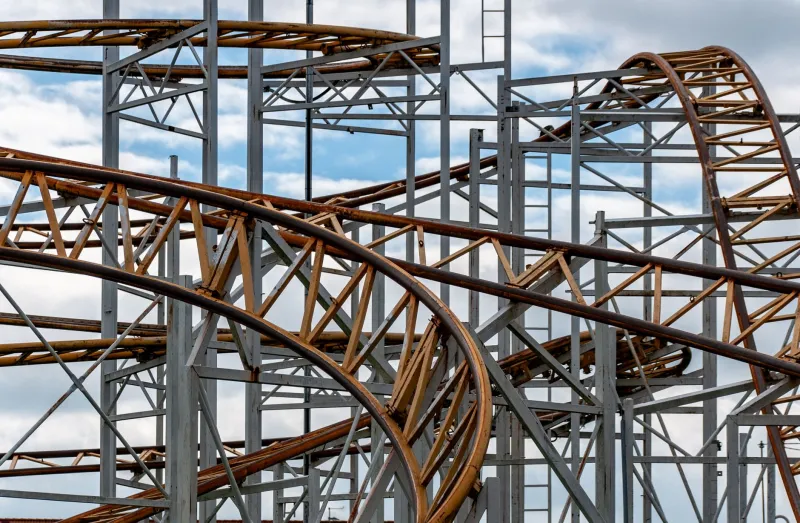
Somewhere in the mid-South, a roller coaster is still standing. Sort of. The lift hill leans at an angle that would make any structural engineer wince, and the queue house is now basically a greenhouse — vines threading through every gap in the plywood, reclaiming the whole structure with a patience that feels almost deliberate. Nobody's ridden it in fifteen years. But somebody photographed it last spring, and that photograph is now sitting in a carefully tagged archive alongside hundreds of others just like it.
That somebody probably didn't have permission to be there.
Welcome to one of the quieter corners of American obsessive culture: the people who document abandoned amusement parks, water parks, and fairgrounds before time erases them completely. It's a niche that lives somewhere between urban exploration, architectural history, and genuine grief — because that's what a lot of this work actually is. Grief, with a wide-angle lens.
Why Amusement Parks, Specifically
Abandoned buildings get photographed all the time. Factories, hospitals, schools — the urbex community has catalogued plenty of them. But amusement parks occupy a different emotional register. These were places explicitly designed to manufacture joy. The colors were loud on purpose. The music was relentless. Everything was built to make you feel something, and feel it fast.
When that machinery stops working and the gates close for the last time, what's left behind carries a specific kind of weight. A rusted Ferris wheel against a gray sky hits differently than a collapsed factory roof. It's supposed to be fun. It was fun. And now it's not anything.
That contrast — engineered delight meeting total abandonment — is exactly what draws this particular community to these particular places. The photographers who do this work talk about it in almost elegiac terms. One forum regular who goes by the handle Midway Ghost described it this way in a post that's been shared probably a thousand times across various Facebook groups and Discord servers: "You're not just photographing decay. You're photographing the last evidence that people came here and screamed and laughed and ate terrible food and had the best day of their summer. That deserves to be recorded."
Hard to argue with that.
The Legal Gray Zone Nobody Talks About Directly
Here's the part that makes this hobby complicated: most of these sites are private property, and most of the people documenting them are not there with anyone's blessing.
The community has developed a kind of informal ethics around this. Trespassing is generally acknowledged as a reality, but there are lines. You don't take anything. You don't break anything to get in. If a gate is unlocked, that's different from cutting a fence. You don't share precise GPS coordinates publicly, because drawing too much attention to a site tends to bring out people who aren't there to document — they're there to vandalize. And vandalism accelerates the timeline toward demolition.
Some of the more experienced documentarians have actually managed to get legitimate access. They contact property owners or holding companies directly, explain what they're doing, and occasionally get a yes. It's rarer than you'd think, but it happens. A few have connected with local historical societies who've used their photographs in preservation efforts or county archive projects.
Most of the time, though, it's early mornings and cut-through gaps in chain link and the low-grade anxiety of not being entirely sure who owns the land you're standing on.
What the Archives Actually Look Like
The documentation side of this is more rigorous than outsiders might expect. This isn't just people posting moody Instagram shots with vague captions. The serious practitioners are meticulous.
A well-maintained abandoned park archive might include floor plans reconstructed from aerial photography, ride-by-ride documentation with historical context pulled from old newspaper ads and park brochures, GPS-tagged photo sets organized by date of visit, and comparison shots showing the same location across multiple years. Some archives track the pace of decay — how fast a particular structure is deteriorating, whether it looks like a demolition crew has been active, whether the vegetation is advancing or pulling back.
There are dedicated websites that function essentially as collaborative encyclopedias for this stuff. Some have been running for over a decade. They have active forums where people debate the history of specific parks, share newly discovered photographs from estate sales or local library collections, and occasionally connect with former employees or ride operators who want to contribute their own memories.
The Americana Obscura community — not a formal organization, more of a loose network — has amassed documentation on dozens of defunct parks across the country, from the well-known failures like Action Park in New Jersey (which has its own entire mythology) to genuinely forgotten regional spots that operated for maybe a decade in the 1970s before quietly folding.
What Gets Lost When Nobody Shows Up
The urgency behind this work isn't abstract. Parks disappear faster than most people realize. A site that looks frozen in time one spring can be completely cleared by fall — either because a developer finally moved on a property, or because the owner decided the liability risk wasn't worth it anymore, or just because a structure finally became too dangerous to leave standing.
When that happens without documentation, specific histories vanish. The regional water park that was the center of every local kid's summer from 1983 to 1997 becomes a rumor, then a vague memory, then nothing. The ride names, the ticket prices, the particular layout of the lazy river — all of it dissolves unless someone thought to record it.
Local newspapers sometimes run retrospectives when a park closes, but those pieces are written for a general audience and rarely capture the granular detail that makes a place feel real in retrospect. The obsessives who show up with cameras and notebooks are often the only people generating the kind of record that historians would actually find useful.
A few academic researchers have started paying attention to these archives. Scholars working on American leisure history, regional tourism, or mid-century commercial architecture have cited photographs from community-maintained sites in actual published work. Which is a strange kind of validation for a hobby that most people's families probably think is at least a little bit weird.
The Clock Is Running
The community tends to prioritize sites that are actively deteriorating or known to have development interest. There's an informal triage system — if word gets out that a property has sold or that permits have been filed, people mobilize fast. The window between "still standing" and "completely gone" can be surprisingly short.
What drives someone to spend a Saturday morning navigating through chest-high weeds toward a structure that might or might not be structurally sound, in a place they're probably not supposed to be, to photograph something most people have never heard of and will never visit?
Midway Ghost had an answer for that too, buried in a follow-up comment on that same forum post: "Because in twenty years, somebody's going to want to know this place existed. I want to be the reason they can."
That's a pretty good reason.