Somewhere Under That Parking Lot, a Thousand Saturday Matinees Are Buried
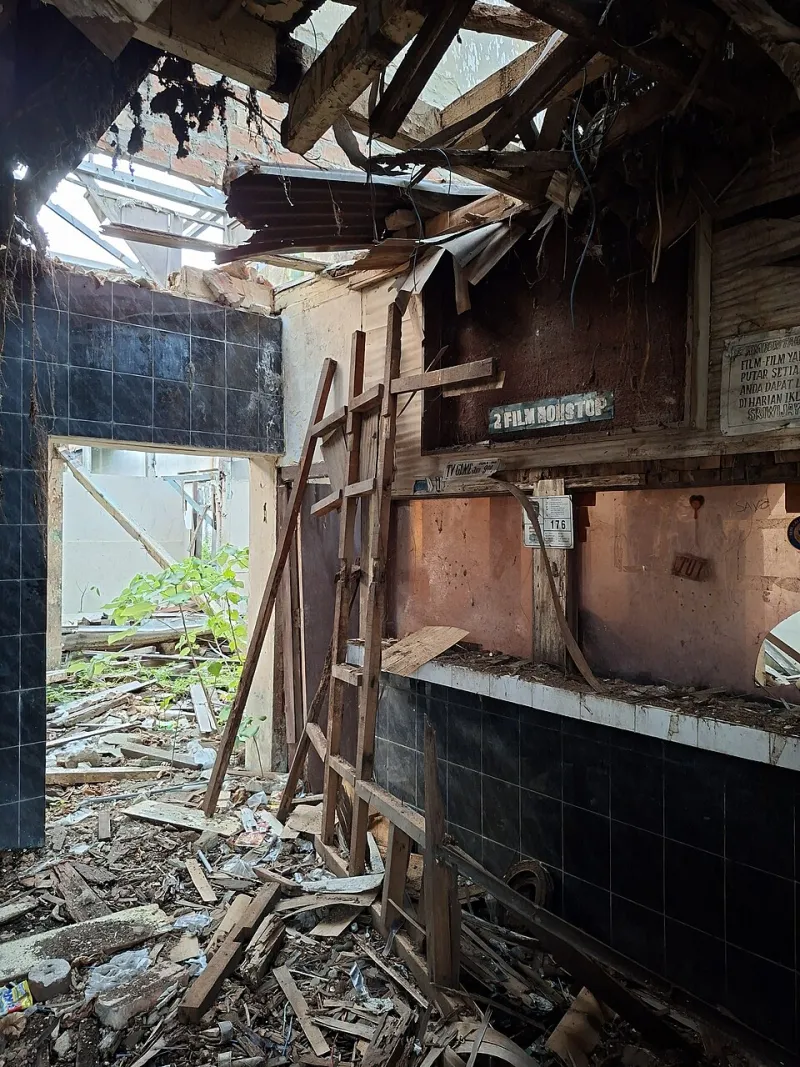
Photo: Swarabakti, CC BY 4.0, via Wikimedia Commons
There's a Walgreens in Dayton, Ohio that used to be a movie theater. You'd never know it from the outside — the facade is that particular shade of corporate beige that erases everything that came before it. But if you zoom into the right satellite view and tilt your head slightly, you can still see the ghost of the old roofline. The footprint is all wrong for a pharmacy. The bones give it away.
People are noticing these bones. A lot of them, actually.
The Project Nobody Commissioned
Cinema Archaeology — the informal name some in the community have started using — isn't a nonprofit. It doesn't have a governing board or a federal grant. It's closer to a distributed obsession: hundreds of individuals scattered across the country, each maintaining their own spreadsheets, photo archives, and Google Earth bookmarks, all circling the same question. Where did all the theaters go, and can we at least write it down before the last people who remember them are gone?
The flagship resource most people point to is CinemaTreasures.org, which has existed in some form since the early 2000s and functions as a kind of Wikipedia for defunct and surviving movie houses. But the real texture of the community lives in smaller corners — Discord servers, dedicated subreddits, Facebook groups run by retired schoolteachers in the Midwest who got into this after recognizing a building in an old photograph. The work is granular, unglamorous, and apparently addictive.
"I started with my hometown," says one contributor who goes by the handle FilmHouseGhost and has been documenting closed theaters in the Mid-Atlantic region for about six years. "I grew up going to this one multiplex that closed when I was maybe twelve. Then I started wondering about the one before that, and the one before that. You pull one thread and the whole thing unravels."
What the Documentation Actually Looks Like
The methods vary, but there's a rough common vocabulary. Google Earth's historical imagery tool is foundational — it lets you scrub back through decades of satellite photos and watch a theater disappear in time-lapse. One year there's a marquee visible from space; a few frames later, the roof is gone; eventually, a big-box store materializes like it was always there.
Street View fills in ground-level detail, though contributors are quick to note its limitations. The cameras don't always catch a building before demolition, and the update cycles are uneven. Rural areas can go years without a new pass. So a lot of the work involves cross-referencing: local newspaper archives, eBay listings for old ticket stubs and lobby cards, Flickr accounts belonging to people who photographed small-town main streets in the 1970s without realizing they were doing preservation work.
Some contributors cold-call county assessor offices to pull old property records. Others have developed relationships with local historical societies that occasionally surface interior photographs — the kind that show the actual seats, the concession stand, the particular carpet pattern that apparently every American multiplex shared from roughly 1987 to 1994.
"That carpet," one member wrote in a recent forum thread, "is its own entire subgenre of documentation."
The Emotional Weight of a Closed Lobby
It would be easy to frame this as nostalgia, and nostalgia is definitely part of it. But the people doing this work tend to push back on that framing, at least a little. There's something more structural happening.
Movie theaters, especially the big downtown palaces built between 1910 and 1940, were often the most architecturally ambitious buildings in their communities. They were designed to make people feel like they were somewhere important. When they closed — first to television, then to multiplexes, then to streaming — something happened to the geography of American public life that we don't have great language for. The spaces where strangers sat together in the dark and watched the same thing at the same time are mostly gone now, and the people mapping their absence seem to be working through what that actually means.
A contributor named Diane, who has cataloged more than 300 closed theaters across six Southern states, puts it plainly: "These weren't just buildings. They were where your town went. When they're gone and nobody records that they existed, it's like that part of the town's memory just gets deleted."
The Streaming Era Closed a Different Kind of Theater
The community draws a distinction between two broad waves of closures. The first swept through downtown cores from the 1950s onward, as suburban flight and TV ownership hollowed out urban foot traffic. The second wave — still ongoing, still raw — is hitting the suburban multiplexes that replaced those old palaces. The ones with stadium seating and twelve screens and a parking lot the size of a small airport.
These are harder to mourn, culturally. They're not architecturally significant. They don't have ornate plasterwork or Wurlitzer organs in the basement. But they were where a lot of people grew up going to the movies, and the community is increasingly treating their closure with the same seriousness. A shuttered AMC in a strip mall exurb of Phoenix gets the same spreadsheet treatment as a demolished 1920s picture palace in Cleveland.
"The Regal that closed near me in 2022 isn't beautiful," FilmHouseGhost admits. "But my kids saw their first movies there. That matters. The record should say it existed."
Why Bother
This is the question that comes up constantly in community discussions, and the answers are all slightly different. Some people are architectural historians in everything but credential. Some are local history buffs who happened to find cinema as their entry point. Some are just people who felt something when a specific building came down and didn't know what to do with that feeling except start a spreadsheet.
What they share is a conviction that the geography of cultural life is worth preserving even when — maybe especially when — the culture itself has moved on. The theaters are gone. The parking lots are full. But someone is out there with a satellite image and a county records request, making sure that somewhere, at least, it's written down.
There's a Walgreens in Dayton, Ohio that used to show movies. Now you know.