Before the Sledgehammer Swings: The People Photographing Vintage Bathroom Tiles Like Their Lives Depend on It
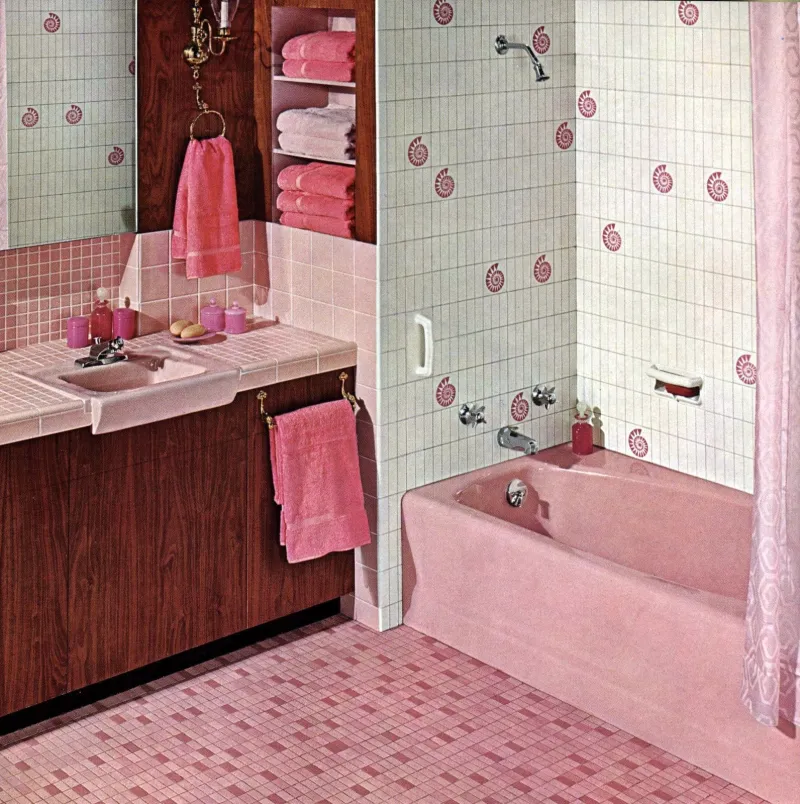
Photo: vintage mid-century bathroom ceramic tiles pink green retro, via clickamericana.com
Demolition moves fast. A house gets condemned, a renovation contract gets signed, and within a few days the walls are open and the floor is gone. Most people don't think twice about what's being lost in that process. A small, quietly determined group of people thinks about almost nothing else.
They're building a digital archive of mid-century American bathroom ceramics — tiles, fixtures, color combinations, manufacturer marks — treating them as design artifacts that deserve the same careful documentation we give to furniture or architecture. The work is unglamorous, often involves trespassing adjacent situations and fast conversations with contractors, and is entirely self-funded. It is also, depending on your angle, either very niche or very important.
What They're Actually Saving
First, some context on what's at stake. American bathrooms from roughly 1930 through the early 1970s were frequently tiled with ceramics that were manufactured domestically, often regionally, by companies that no longer exist. The color palettes — the dusty pinks, the seafoam greens, the two-tone combinations that read as aggressively dated now but were genuinely sophisticated design at the time — were the product of specific industrial processes that aren't being replicated.
When a house from that era gets renovated, the tile almost always goes. Homeowners want the look of the moment. Contractors are faster with a sledgehammer than a chisel. And the tile, which might be the only surviving physical record of what a now-defunct Ohio ceramics manufacturer was producing in 1952, ends up in a construction dumpster.
"Once it's gone, it's gone," said one archivist who runs a database cataloging tiles by manufacturer, era, and geographic region. She started the project after watching a 1940s bathroom get gutted during a neighborhood renovation and realizing she had no way to identify the tile pattern or find out who made it. "There's no central record. There's no institution doing this. So we're doing it."
The Database Is More Sophisticated Than You'd Expect
The archive this community is building isn't just a photo album. It's a structured database with fields for manufacturer (when identifiable), approximate production date range, color notation using standardized codes, country and state of origin, installation context, and condition at time of documentation.
Manufacturer identification is one of the more technically demanding parts of the work. Many tiles carry no visible markings. Experienced contributors have developed identification methods based on clay body composition, glaze characteristics, tile thickness, and back-stamp patterns — the faint impressions sometimes left on the reverse side of a tile during manufacturing. There are guides, developed collaboratively over years, that walk newer members through the process.
The geographic tagging matters more than it might seem. Certain manufacturers distributed primarily regionally, which means a particular tile pattern might show up consistently in mid-century homes in one part of the country and almost nowhere else. Mapping those distributions tells you something about supply chains, about regional taste, about how design ideas moved through the country in the postwar period.
Getting Access Before the Wrecking Crew Does
The logistics of documentation are genuinely complicated. The best opportunities come when a house is already in demolition — when the tile is accessible but hasn't been destroyed yet. That window can be hours or days, and it requires knowing about the demolition in advance.
The community has developed a loose early-warning network. Contractors who are sympathetic to the project sometimes send messages before a job starts. Historic preservation contacts pass along leads on condemned properties. Real estate listings for houses described as "gut renovation candidates" get monitored. Local Facebook groups and Nextdoor threads about neighborhood development get watched carefully.
"You'd be surprised how many contractors are actually into it once you explain what you're doing," said one contributor based in the mid-Atlantic who has documented over 400 individual tile installations. "They're not trying to destroy history. They just have a job to do. If you show up with a camera and you're not slowing them down, most of them are fine with it."
Some salvage operations go further than photography. A subset of contributors focuses on physically recovering intact tiles — either negotiating with contractors or pulling them personally from already-open walls. These pieces end up in personal collections, sometimes in small community repositories, and occasionally get donated to local historical societies that are willing to take them.
The Design Conversation Happening Underneath
There's a secondary discourse running through these communities that's less about preservation and more about design history. Mid-century bathroom aesthetics have been having a cultural moment for a while now — the vintage-inspired tile trend in contemporary design is real and commercially significant. But the conversation happening in these archiving spaces is more specific and more critical.
Contributors push back on the idea that contemporary "retro" tile is a genuine continuation of the mid-century tradition. The manufacturing processes are different. The color formulations are different. The tiles that come out of modern production lines inspired by 1950s aesthetics are, in their view, references to a thing rather than the thing itself — and an imprecise reference at that.
"There's a real irony," noted one contributor who writes occasional long-form posts on the community's shared blog. "The aesthetic is more popular than it's been in decades, and simultaneously the actual artifacts are being destroyed faster than ever because people are renovating to get that look. The inspiration and the demolition are happening at the same time."
A Museum That Doesn't Have a Building
What this community is building is, functionally, a museum. It has a collection, a cataloging system, a research methodology, and a preservation mission. What it doesn't have is an institution behind it, a physical space, or any formal recognition.
That's fine with most of the people involved. Institutions move slowly. Institutions have committees. The tile is disappearing right now, and a distributed network of people with cameras and spreadsheets can move faster than any grant application process.
The archive is accessible to researchers, to historic preservationists, to homeowners trying to identify what they have before they decide whether to keep it. It's also accessible to anyone who's just curious about the specific shade of pink that seemed to appear in every American bathroom built between 1948 and 1962.
Somewhere, right now, a contractor is pulling tile off a wall. Somewhere else, someone with a camera is trying to get there first.