Tabletop Downtown: The Miniaturists Rebuilding Department Store Christmas Windows
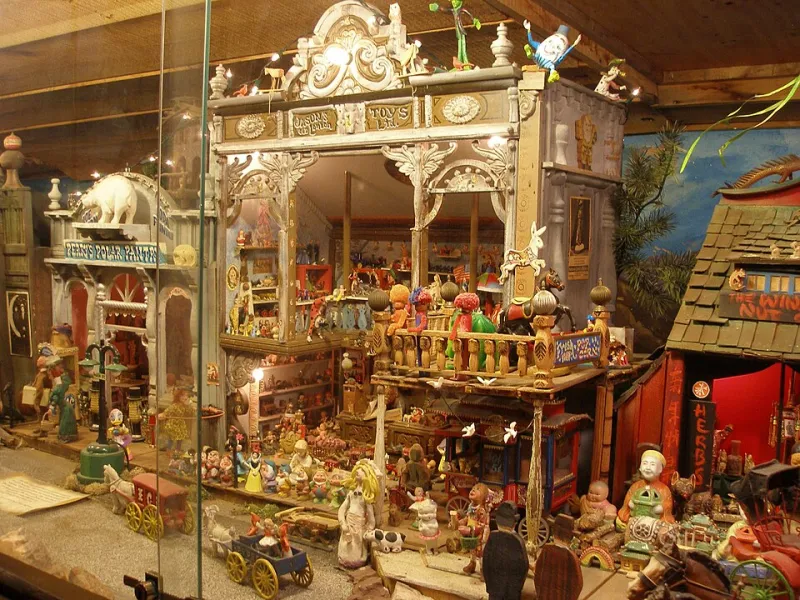
Photo: Unknown authorUnknown author or not provided, Public domain, via Wikimedia Commons
The scene is tucked into a spare bedroom in a suburban house outside Columbus, Ohio. A miniature department store window glows under an LED strip. Inside, a tiny Santa waves from a sleigh no bigger than a thumb. The snow is ground glass. The velour curtain was cut from a scrap of vintage fabric found at an estate sale. The whole thing measures about eighteen inches across, but it is trying to hold an entire downtown Christmas season inside it.
Across the country, a small and somewhat scattered group of miniaturists, former window dressers, and department store historians is rebuilding the elaborate holiday windows that once drew crowds to places like Marshall Field's, Wanamaker's, Famous-Barr, and Higbee's. The originals are mostly gone—sold, scrapped, or lost when the stores closed. The reconstructions are not exact replicas. They are research projects with tinsel, built from old photographs, employee memories, and salvaged props that somehow survived decades in a basement.
The Window Was the Show
Before online shopping and suburban malls, the downtown department store window was civic theater. Families rode buses downtown specifically to see the holiday display. Stores competed with animatronics, hand-painted backdrops, and scenes that told a story from window to window. The windows were free, which made them democratic. They were also temporary, which is why so little survives.
The people who built them were craftspeople: carpenters, painters, electricians, seamstresses, and window trimmers who worked all year on a display that might run six weeks. Their names rarely appeared in the newspaper. The store got the credit. When the stores closed, the craft knowledge scattered. Some trimmers went into museum work or theater. Others left the trade entirely. The windows themselves were often destroyed because nobody had space to store a life-size reindeer made of papier-mâché and chicken wire.
Rebuilding from Snapshots and Muscle Memory
The reconstruction process starts with images. Miniaturists collect newspaper photos, family snapshots, and promotional brochures. They enlarge them, squint at the backgrounds, and try to identify colors that faded in the printing. Then they find the people. A retired trimmer might remember that the snow was not cotton but a specific kind of flocking. A former electrician might explain how the motorized figures were timed. A store employee might recall that the window theme changed every two years, not every year, which changes the timeline.
The miniaturists work at 1:12 scale, the standard for dollhouse-size rooms. That means a six-foot Santa becomes six inches. A window backdrop becomes a sheet of painted card. The challenge is not just shrinking objects. It is capturing the proportions and the lighting. Department store windows were designed to be seen from the sidewalk, at night, through glass. The miniatures have to recreate that glow without the crowd. Some builders use fiber optics. Others use tiny LEDs and layers of translucent paper. A few have taught themselves animatronics just to make a miniature figure turn its head.
The Craft Nobody Archived
The deeper investigation is about materials and methods. Window displays used a lot of things that were never meant to last: paper flowers, spun glass, painted canvas, wax figures, and electrical wiring that would fail a modern inspection. Miniaturists trade notes on how to fake these materials at small scale. They cast resin copies of ornaments. They dye fabric to match a faded photo. They hunt for vintage trims and beads that match the period.
The research often hits dead ends. Store archives were not always preserved. Unions kept some records, but not detailed build notes. Newspapers covered the finished windows, not the weeks of work behind them. So the miniaturists rely on oral history. A former trimmer might not remember the exact shade of red, but they remember the argument about it. That kind of detail does not make it into a photo, but it makes the reconstruction feel less like a model and more like a memory.
Why the Spare Bedroom Matters
This holiday season, some of the most detailed department store windows in America will not be on a sidewalk. They will be in a spare bedroom, a basement, or a local library display case. That might sound like a letdown. It is not. The miniatures are doing something the original windows could not: they are keeping the craft visible after the stores are gone.
They are also a form of civic nostalgia that does not rely on a building. A town can lose its downtown anchor store and still keep the memory of the window that made people stop in the cold. The miniaturists are not trying to reopen the stores. They are trying to preserve the evidence that someone once built a tiny world just to make a sidewalk feel like Christmas. That work is slow, obsessive, and mostly unseen. Which is exactly why it fits the quietly curious corner of the internet where SpotDW tends to hang out.